imToken Wallet: A Complete Overview of Its Multi-Chain Features
What Is imToken?
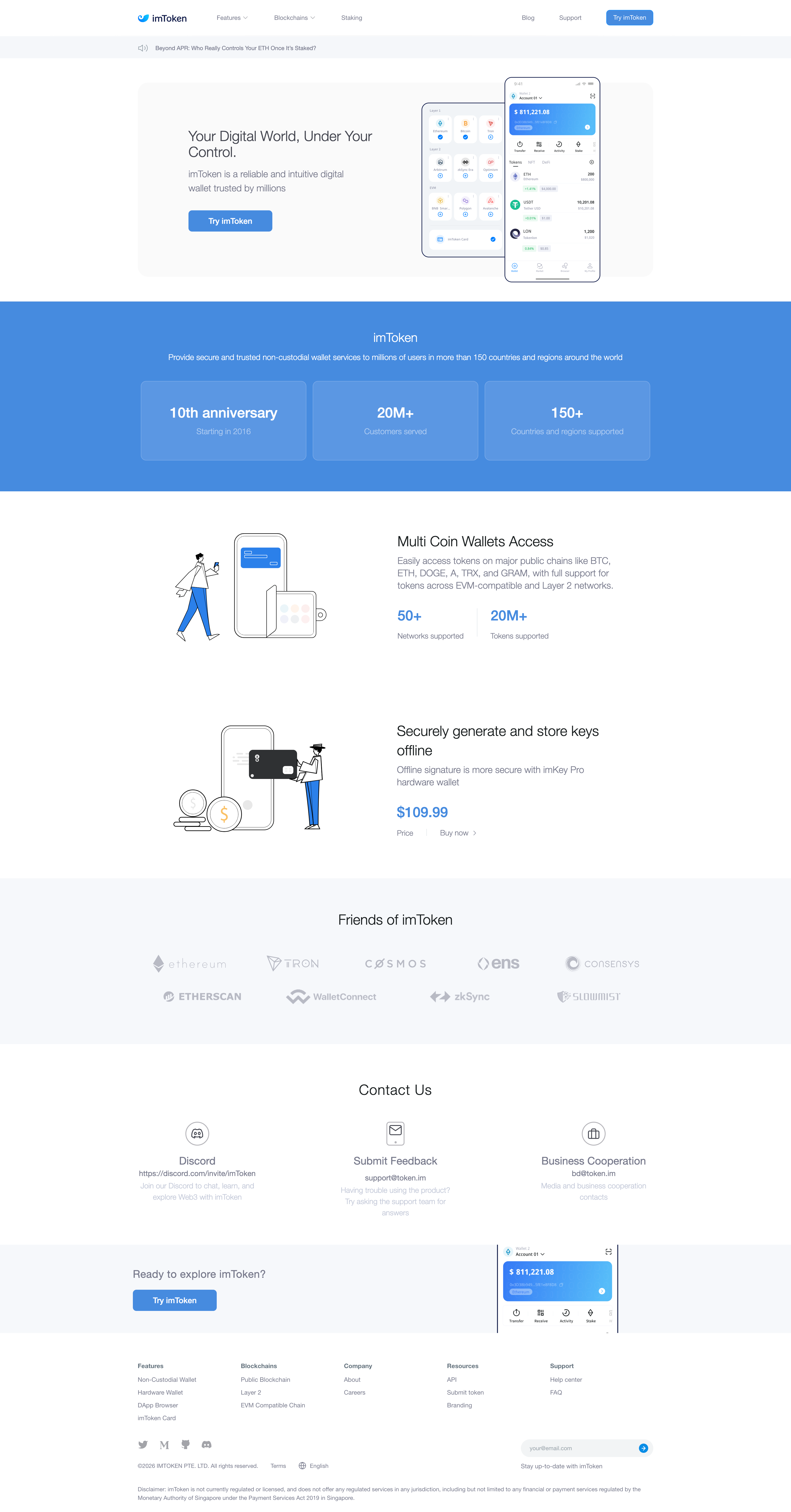
imToken is a self-custodial cryptocurrency wallet that enables users to manage digital assets across multiple blockchain networks. Unlike a centralized cryptocurrency exchange, imToken does not function as a conventional custodial account where the company holds users' funds on their behalf.
In a non-custodial wallet, users are responsible for their wallet credentials, including their mnemonic phrase and private keys. This gives users direct control over their assets but also places greater responsibility on them to protect their security information.
imToken supports major networks including Bitcoin, Ethereum, TRON, Cosmos, Litecoin, Bitcoin Cash, Polkadot, TON, and several Layer 2 and EVM-compatible networks. Its official support documentation was updated in September 2026 and lists a broad range of networks and tokens.
History of imToken
imToken was launched in 2016 and initially became known as an Ethereum-focused mobile wallet. Over time, the platform expanded its functionality and added support for additional blockchain ecosystems.
As the cryptocurrency market developed, the need for multi-chain wallets increased. Ethereum's ecosystem expanded into Layer 2 networks, while alternative blockchains such as TRON, Bitcoin, Cosmos, Polkadot, and others developed their own applications and token ecosystems.
imToken responded by expanding its supported networks and adding features beyond basic asset storage.
Today, the platform positions itself as a broader digital asset management tool rather than simply an Ethereum wallet. Its official website describes the company as having reached its tenth anniversary and serving more than 20 million customers across more than 150 countries and regions.
How imToken Works
The basic purpose of imToken is to give users control over blockchain accounts through a single wallet application.
When creating a wallet, users receive a mnemonic or recovery phrase that can be used to restore access to their wallet. The private keys associated with the wallet are used to authorize blockchain transactions.
When a user sends cryptocurrency, imToken creates and signs the transaction. The transaction is then broadcast to the relevant blockchain network, where it is processed according to that network's rules.
Because imToken is non-custodial, users do not need to ask the company to approve ordinary blockchain transactions. The wallet acts as an interface between the user and the blockchain.
This structure gives users greater independence but means that losing a recovery phrase or exposing private keys can create serious consequences.
Multi-Chain Support
One of imToken's biggest advantages is its multi-chain functionality.
The wallet currently supports major public blockchains such as Bitcoin, Ethereum, TRON, Cosmos, Vaulta, Nervos, Bitcoin Cash, Litecoin, Polkadot, Kusama, Filecoin, Tezos, Dogechain, Osmosis, and TON. It also supports numerous Layer 2 networks and EVM-compatible chains.
For Ethereum users, imToken supports ERC-20, ERC-721, and ERC-1155 assets. It also supports TRON's TRC-10 and TRC-20 token standards.
The wallet's support for Layer 2 networks includes ecosystems such as Arbitrum, Optimism, Base, zkSync Era, Scroll, Linea, Polygon zkEVM, Blast, Taiko, and others.
This broad compatibility can be useful for users who regularly move between different blockchain ecosystems.
Managing Tokens With imToken
imToken provides tools for organizing and displaying supported tokens inside a wallet account.
Commonly recognized tokens can be detected automatically after being transferred to an account or after a wallet is imported. Users can also search for assets or add supported custom tokens using contract addresses on compatible networks.
This is particularly useful for users managing large numbers of ERC-20 or other blockchain-based assets.
However, users should be careful when adding custom tokens. Multiple assets can have identical or similar names, so the contract address is an important way to distinguish between legitimate and fraudulent tokens.
A token appearing in a wallet does not automatically mean that it has value or that its associated project is trustworthy.
Bitcoin Support
Bitcoin is one of the major assets supported by imToken.
The wallet provides functionality for managing Bitcoin accounts and supports multiple Bitcoin address formats, including SegWit and Taproot addresses.
Bitcoin's architecture differs significantly from Ethereum's account and smart-contract model, so supporting Bitcoin alongside EVM networks requires the wallet to handle different blockchain systems.
For users who hold both BTC and Ethereum-based assets, having access to both ecosystems through one wallet can simplify basic portfolio management.
Ethereum and EVM Networks
Ethereum remains an important part of imToken's ecosystem.
The wallet supports ETH and Ethereum-based tokens and provides access to numerous EVM-compatible networks. These networks allow users to interact with decentralized applications while often offering different transaction costs and performance characteristics from Ethereum mainnet.
imToken also provides tools for configuring supported blockchain networks. Users can select from recognized networks or, where appropriate, configure custom EVM networks by entering information such as an RPC endpoint, chain ID, symbol, and block explorer.
Custom network functionality can be useful for experienced users, but it introduces additional responsibility. imToken specifically warns that it cannot verify the security or stability of third-party RPC nodes, so users should carefully verify network information before adding custom configurations.
Decentralized Applications
imToken includes a built-in DApp browser that allows users to access compatible decentralized applications from within the wallet.
According to imToken's documentation, users can access applications such as decentralized exchanges, governance platforms, and other Web3 services through the browser.
This means the wallet can function as more than a place to store cryptocurrency. It can also act as a gateway to decentralized applications.
For example, a user could connect to a decentralized exchange to swap tokens or interact with an on-chain governance application.
However, DApp interaction introduces additional risks. Users should carefully verify websites, contracts, transaction details, and permissions before signing transactions.
Token Swapping
imToken also provides access to token-swapping functionality through its ecosystem.
Its documentation describes the Market section as an area where users can monitor market trends and access token swaps through Tokenlon.
Token swapping allows users to exchange one supported cryptocurrency for another without necessarily transferring assets to a centralized exchange first.
The actual cost of a swap can depend on factors such as network fees, liquidity, price impact, and any applicable service or protocol charges.
Users should always review the final transaction details before approving a swap.
Staking and DeFi
Another important area of imToken is decentralized finance.
Depending on the supported network and current product availability, users can access staking and other blockchain-based financial applications through the wallet and its DApp ecosystem.
Staking allows users to participate in proof-of-stake networks by helping secure the network or delegating assets to validators. In return, participants may receive rewards according to the rules of the relevant blockchain.
DeFi applications can also provide services such as decentralized exchanges, lending, liquidity provision, and other financial functions.
These services can create opportunities but also involve significant risks. Smart-contract vulnerabilities, market volatility, liquidity problems, and protocol-specific risks can lead to financial losses.
Hardware Wallet Integration
For users holding significant amounts of cryptocurrency, hardware wallets can provide additional protection.
imToken supports hardware-wallet functionality and promotes offline signing through its imKey hardware wallet. The goal is to keep sensitive key material separated from an internet-connected device.
Hardware wallets do not eliminate every risk, but they can reduce exposure to certain types of online attacks.
Users should still verify transaction information carefully on their hardware device before signing.
Benefits of imToken
imToken offers several advantages for cryptocurrency users.
Multi-chain support: Users can manage assets across Bitcoin, Ethereum, TRON, Cosmos, TON, Layer 2 networks, and numerous EVM-compatible chains.
Non-custodial design: Users maintain control over their private keys and wallet assets.
DApp access: The integrated browser provides a gateway to decentralized applications.
Token management: Users can organize and add supported assets across different networks.
Security tools: Address warnings, risk labels, hardware-wallet support, and security audits provide additional layers of protection.
Broad ecosystem: The wallet combines asset management, Web3 access, and token-swapping functionality.
These features make imToken suitable for users who want a single interface for managing a diverse blockchain portfolio.
The Future of imToken
The future of cryptocurrency wallets is likely to become increasingly multi-chain.
As Layer 2 networks, alternative blockchains, tokenized assets, and decentralized applications continue to expand, users will need interfaces that make different blockchain ecosystems easier to manage.
imToken's existing focus on multi-chain assets, DApps, hardware wallets, and security tools positions it within this broader trend.
The wallet's continuing expansion of supported networks also demonstrates how quickly the blockchain environment is changing. Its current documentation already includes a wide range of newer EVM networks alongside established chains.
Future wallet development may increasingly focus on simplifying blockchain complexity while giving users better visibility into transaction risks.
Conclusion
imToken is a long-running non-custodial cryptocurrency wallet that has evolved from an Ethereum-focused application into a broad multi-chain digital asset management platform. It currently supports major networks such as Bitcoin, Ethereum, TRON, Cosmos, Polkadot, TON, and numerous Layer 2 and EVM-compatible ecosystems.
Its combination of multi-chain asset management, DApp access, token swapping, staking-related functionality, security tools, and hardware-wallet support makes it a versatile option for cryptocurrency users.
The wallet's non-custodial structure provides users with direct control over their assets, but that control comes with responsibility. Protecting the recovery phrase, checking recipient addresses, verifying blockchain networks, and carefully reviewing DApp transactions are essential parts of using the wallet safely.
As blockchain technology continues moving toward a multi-chain future, wallets such as imToken will remain important interfaces between users and decentralized networks. Its broad network support and expanding security features make it a notable participant in the cryptocurrency wallet market, while users should continue to conduct their own research and follow strong security practices when managing digital assets.